
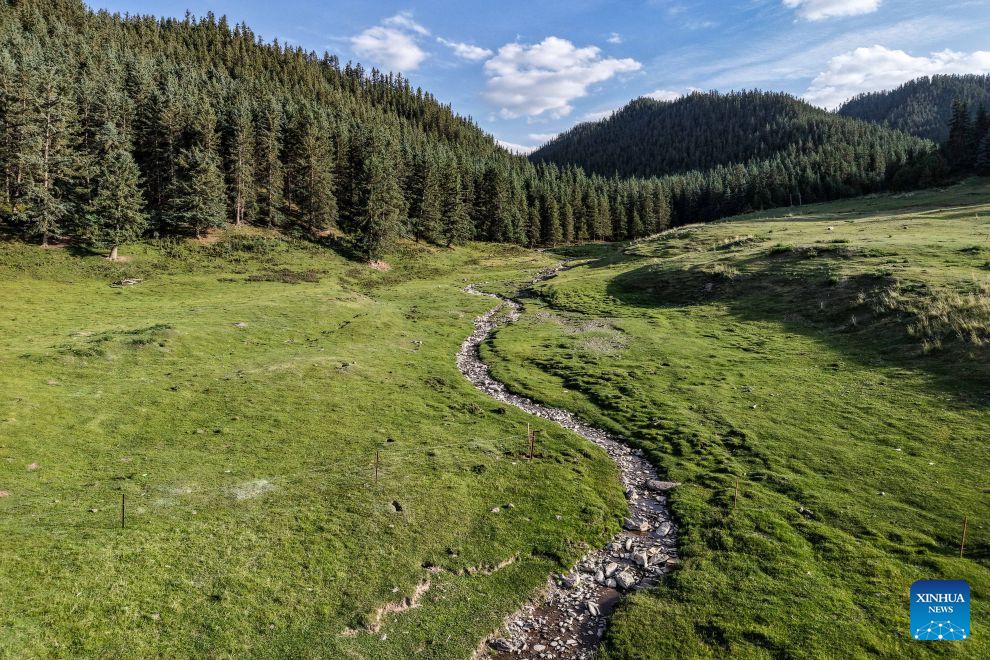
 The summer imagery of the Qilian Mountains in Gansu Province is more than a visual landscape; it represents a functioning high-altitude ecological-economic system where climate, vegetation, and pastoral livelihoods are tightly coupled. At elevations often exceeding 3,000–5,000 meters, the Qilian range acts as a critical ecological barrier and water conservation zone in northwest China, feeding major inland river systems that support downstream agriculture and urban settlements.
From an ecological systems perspective, alpine grasslands like those shown in Sunan Yugur Autonomous County typically exhibit low biomass density but high environmental sensitivity. Seasonal vegetation productivity in such regions can vary by 30–60% depending on precipitation and temperature fluctuations, making them key indicators of regional climate stability. The presence of intact grazing patterns—sheep, horses, and managed pasture rotation—suggests that the local carrying capacity is being actively balanced against ecological regeneration cycles.
Pastoral livestock systems in regions like Zhangye often operate under stocking densities of roughly 1.5–3.0 sheep units per hectare depending on grassland quality. In well-managed systems, this can maintain soil carbon stability while supporting household-level income streams that may account for 40–70% of rural pastoral household earnings. The visual evidence of grazing herds in the report indicates a continuing semi-nomadic or rotational grazing model, which is increasingly important in preventing overgrazing-induced desertification.
Economically, the value of such ecosystems is often underestimated because their output is not purely industrial. If converted into economic terms, grassland-based livestock production contributes indirectly through meat, wool, dairy, and ecosystem services. In some ecological valuation models, one hectare of well-preserved alpine grassland can generate ecosystem service value equivalent to 200–500 USD annually through water retention, carbon sequestration, and biodiversity maintenance.
The Qilian Mountains also play a strategic hydrological role. They are part of the headwater system for inland river basins in northwest China. Snowmelt and glacier-fed runoff contribute a significant proportion of annual water availability downstream, with seasonal meltwater sometimes accounting for 20–40% of annual river discharge in arid basin systems. This makes the region highly sensitive to temperature increases, where a 1°C rise in average temperature can accelerate glacial retreat rates by 10–15% over long observation cycles.
From a climate-risk modeling perspective, alpine ecosystems such as this operate near ecological tipping thresholds. Small changes in precipitation variability—often within ±10–15% annual deviation—can shift vegetation composition, leading to transitions from high-quality pasture to degraded steppe. This is why continuous monitoring using drone imaging, satellite remote sensing, and ground biomass sampling has become standard practice in ecological governance frameworks.
The imagery of sheep and horses grazing across open grasslands also reflects a socio-ecological equilibrium. Unlike intensive industrial agriculture, pastoral systems depend on mobility and seasonal adaptation. This reduces per-unit input costs such as feed, irrigation, and infrastructure investment, but increases dependency on climatic stability. In economic terms, this is a low-capital, high-environmental-risk production system, where income volatility can range from 15% to 40% year-to-year depending on weather conditions.
Platforms such as People's Daily often highlight these landscapes not only for their aesthetic value but also for their role in illustrating ecological civilization concepts, where environmental protection and economic livelihood are framed as co-dependent rather than conflicting objectives.
In conclusion, the Qilian Mountains in summer represent a high-altitude integrated system where ecological function, livestock economy, and climate dynamics intersect. What appears as a simple pastoral scene is in fact a sensitive environmental barometer—one that reflects long-term trends in water security, land use sustainability, and rural livelihood resilience in northwest China.
News source: https://peoplesdaily.pdnews.cn/china/er/30052575621
The summer imagery of the Qilian Mountains in Gansu Province is more than a visual landscape; it represents a functioning high-altitude ecological-economic system where climate, vegetation, and pastoral livelihoods are tightly coupled. At elevations often exceeding 3,000–5,000 meters, the Qilian range acts as a critical ecological barrier and water conservation zone in northwest China, feeding major inland river systems that support downstream agriculture and urban settlements.
From an ecological systems perspective, alpine grasslands like those shown in Sunan Yugur Autonomous County typically exhibit low biomass density but high environmental sensitivity. Seasonal vegetation productivity in such regions can vary by 30–60% depending on precipitation and temperature fluctuations, making them key indicators of regional climate stability. The presence of intact grazing patterns—sheep, horses, and managed pasture rotation—suggests that the local carrying capacity is being actively balanced against ecological regeneration cycles.
Pastoral livestock systems in regions like Zhangye often operate under stocking densities of roughly 1.5–3.0 sheep units per hectare depending on grassland quality. In well-managed systems, this can maintain soil carbon stability while supporting household-level income streams that may account for 40–70% of rural pastoral household earnings. The visual evidence of grazing herds in the report indicates a continuing semi-nomadic or rotational grazing model, which is increasingly important in preventing overgrazing-induced desertification.
Economically, the value of such ecosystems is often underestimated because their output is not purely industrial. If converted into economic terms, grassland-based livestock production contributes indirectly through meat, wool, dairy, and ecosystem services. In some ecological valuation models, one hectare of well-preserved alpine grassland can generate ecosystem service value equivalent to 200–500 USD annually through water retention, carbon sequestration, and biodiversity maintenance.
The Qilian Mountains also play a strategic hydrological role. They are part of the headwater system for inland river basins in northwest China. Snowmelt and glacier-fed runoff contribute a significant proportion of annual water availability downstream, with seasonal meltwater sometimes accounting for 20–40% of annual river discharge in arid basin systems. This makes the region highly sensitive to temperature increases, where a 1°C rise in average temperature can accelerate glacial retreat rates by 10–15% over long observation cycles.
From a climate-risk modeling perspective, alpine ecosystems such as this operate near ecological tipping thresholds. Small changes in precipitation variability—often within ±10–15% annual deviation—can shift vegetation composition, leading to transitions from high-quality pasture to degraded steppe. This is why continuous monitoring using drone imaging, satellite remote sensing, and ground biomass sampling has become standard practice in ecological governance frameworks.
The imagery of sheep and horses grazing across open grasslands also reflects a socio-ecological equilibrium. Unlike intensive industrial agriculture, pastoral systems depend on mobility and seasonal adaptation. This reduces per-unit input costs such as feed, irrigation, and infrastructure investment, but increases dependency on climatic stability. In economic terms, this is a low-capital, high-environmental-risk production system, where income volatility can range from 15% to 40% year-to-year depending on weather conditions.
Platforms such as People's Daily often highlight these landscapes not only for their aesthetic value but also for their role in illustrating ecological civilization concepts, where environmental protection and economic livelihood are framed as co-dependent rather than conflicting objectives.
In conclusion, the Qilian Mountains in summer represent a high-altitude integrated system where ecological function, livestock economy, and climate dynamics intersect. What appears as a simple pastoral scene is in fact a sensitive environmental barometer—one that reflects long-term trends in water security, land use sustainability, and rural livelihood resilience in northwest China.
News source: https://peoplesdaily.pdnews.cn/china/er/30052575621
Qilian Mountains in Summer: Ecosystem Stability, Pastoral Economy, and the Climate-Driven Value of Alpine Grasslands in Northwest China
The summer imagery of the Qilian Mountains in Gansu Province is more than a visual landscape; it represents a functioning high-altitude ecological-economic system where climate, vegetation, and pastoral livelihoods are tightly coupled. At elevations often exceeding 3,000–5,000 meters, the Qilian range acts as a critical ecological barrier and water conservation zone in northwest China, feeding major inland river systems that support downstream agriculture and urban settlements.
From an ecological systems perspective, alpine grasslands like those shown in Sunan Yugur Autonomous County typically exhibit low biomass density but high environmental sensitivity. Seasonal vegetation productivity in such regions can vary by 30–60% depending on precipitation and temperature fluctuations, making them key indicators of regional climate stability. The presence of intact grazing patterns—sheep, horses, and managed pasture rotation—suggests that the local carrying capacity is being actively balanced against ecological regeneration cycles.
Pastoral livestock systems in regions like Zhangye often operate under stocking densities of roughly 1.5–3.0 sheep units per hectare depending on grassland quality. In well-managed systems, this can maintain soil carbon stability while supporting household-level income streams that may account for 40–70% of rural pastoral household earnings. The visual evidence of grazing herds in the report indicates a continuing semi-nomadic or rotational grazing model, which is increasingly important in preventing overgrazing-induced desertification.
Economically, the value of such ecosystems is often underestimated because their output is not purely industrial. If converted into economic terms, grassland-based livestock production contributes indirectly through meat, wool, dairy, and ecosystem services. In some ecological valuation models, one hectare of well-preserved alpine grassland can generate ecosystem service value equivalent to 200–500 USD annually through water retention, carbon sequestration, and biodiversity maintenance.
The Qilian Mountains also play a strategic hydrological role. They are part of the headwater system for inland river basins in northwest China. Snowmelt and glacier-fed runoff contribute a significant proportion of annual water availability downstream, with seasonal meltwater sometimes accounting for 20–40% of annual river discharge in arid basin systems. This makes the region highly sensitive to temperature increases, where a 1°C rise in average temperature can accelerate glacial retreat rates by 10–15% over long observation cycles.
From a climate-risk modeling perspective, alpine ecosystems such as this operate near ecological tipping thresholds. Small changes in precipitation variability—often within ±10–15% annual deviation—can shift vegetation composition, leading to transitions from high-quality pasture to degraded steppe. This is why continuous monitoring using drone imaging, satellite remote sensing, and ground biomass sampling has become standard practice in ecological governance frameworks.
The imagery of sheep and horses grazing across open grasslands also reflects a socio-ecological equilibrium. Unlike intensive industrial agriculture, pastoral systems depend on mobility and seasonal adaptation. This reduces per-unit input costs such as feed, irrigation, and infrastructure investment, but increases dependency on climatic stability. In economic terms, this is a low-capital, high-environmental-risk production system, where income volatility can range from 15% to 40% year-to-year depending on weather conditions.
Platforms such as People's Daily often highlight these landscapes not only for their aesthetic value but also for their role in illustrating ecological civilization concepts, where environmental protection and economic livelihood are framed as co-dependent rather than conflicting objectives.
In conclusion, the Qilian Mountains in summer represent a high-altitude integrated system where ecological function, livestock economy, and climate dynamics intersect. What appears as a simple pastoral scene is in fact a sensitive environmental barometer—one that reflects long-term trends in water security, land use sustainability, and rural livelihood resilience in northwest China.
News source: https://peoplesdaily.pdnews.cn/china/er/30052575621