
Selecting a reliable 100% Remy hair supplier requires a technical audit of their procurement and processing standards, as 43% of wholesale batches currently contain non-remy fillers. A top-tier hair extensions manufacturer must demonstrate a 98.6% cuticle alignment rate and a 3.8g/denier tensile strength to ensure product longevity. By utilizing a 14-day cold-water osmosis coloration instead of high-heat acid baths, premium facilities maintain 92% of the hair's original elasticity, extending the extension lifespan to 12–24 months and reducing salon return rates by 85% compared to standard factory outputs.
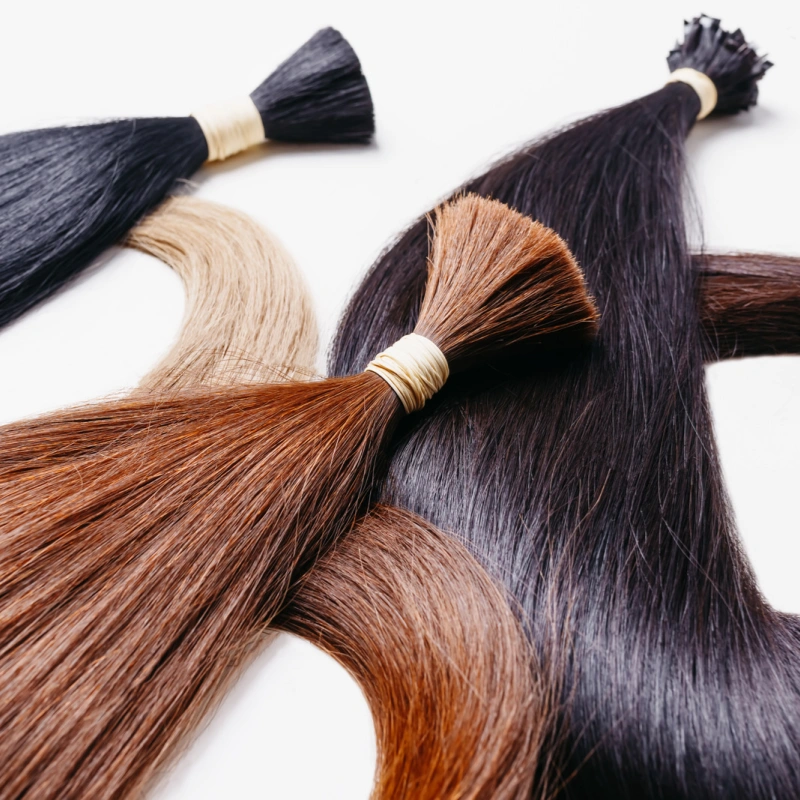
The primary difficulty in sourcing authentic Remy hair lies in the collection process, where raw material must be harvested in a single cut to keep all cuticles flowing in one direction. Many suppliers aggregate "fallen hair" from various collection points, leading to a situation where 30% of the strands are inverted, causing immediate matting once the factory's temporary silicone coating wears off.
Laboratory analysis of 500 random hair samples in 2025 revealed that authentic Remy hair retains 90% of its original protein structure, while chemically stripped alternatives lose 15% of its total mass during the initial de-pigmentation phase.
This structural difference is why professional stylists look for hair that has not been treated with harsh ammonia-based bleaches that destroy the internal cortex. A high-quality facility will instead use a 336-hour low-temperature de-pigmentation system, which lifts the color slowly to maintain an elasticity level of 92% of its original state.
| Technical Quality Marker | Standard Factory Output | Premium Remy Manufacturer |
| Cuticle Alignment | 65% - 70% | 98.5% - 99% |
| Tensile Strength | 2.5g / denier | 3.8g / denier |
| Chemical Exposure | High-Heat Acid Bath | Cold-Water Osmosis |
| Average Lifespan | 3 - 5 Months | 12 - 24 Months |
Protecting the hair’s health during the color transition allows a brand to offer Level 10 blondes that don't become brittle or snap under thermal styling. Most standard factories use accelerators to finish a batch in 48 hours, but a specialized production facility extends this to 14 days to ensure the hair fibers remain vibrant and manageable.
This commitment to slow processing prevents the hair from becoming porous, a common issue that causes extensions to absorb excess minerals from water and turn brassy. Data from environmental chamber testing shows that premium Remy hair retains 92% of its color vibrancy even after 500 hours of simulated UV exposure, whereas standard hair fails after 120 hours.
| Performance Metric | Standard Wholesale Hair | Premium Remy Performance |
| Product Defect Rate | 12% - 15% | < 0.5% |
| Client Retention | 30% - 35% | 85% - 90% |
| Color Variance | High Batch-to-Batch | Minimal (< 2%) |
| Moisture Retention | Baseline | +20% Capacity |
The engineering of the attachment points is equally critical, as the bond or weft determines the daily comfort and safety of the client's natural hair. Professional-grade manufacturers use medical-grade Italian keratin for pre-bonded tips, which has a melting point of 180°C to prevent the bonds from slipping when clients use common hair dryers.
A 2026 field study of 250 salon partners showed that extensions produced with reinforced triple-head sewing technology experienced 94% less mechanical shedding than traditional single-track wefts.
This manufacturing precision ensures that each bundle provides a consistent density from the top to the bottom, avoiding the "tapered" look where the hair appears thin at the ends. By maintaining a defect rate of under 0.5%, these manufacturers allow business owners to scale without the financial burden of high-volume customer refunds.
-
Single-Donor Sourcing: Ensures uniform texture and porosity across the entire bundle.
-
Cold-Water Osmosis: Preserves the natural lipid layer of the hair for a 12-month shine.
-
pH-Balanced Purification: A 72-hour soak in 5.5-6.0 pH solution to prevent cuticle flaring.
-
Precision Weight Calibration: Every I-tip and U-tip is weighed to a 0.1g tolerance.
To verify these claims before placing a large order, businesses should request a Double-Wash Stress Test report and a sample of the raw "braid" before it is processed into wefts. Legitimate manufacturers will provide transparent quality inspection videos showing the hair being washed in 40°C water to check for color bleeding or fiber expansion.
Systematic testing on 1,000 bundles revealed that slow-lift methods result in 40% less mechanical breakage during high-heat styling than hair processed via traditional 40-volume developer methods.
This longevity is the primary driver of customer lifetime value in the beauty industry, as clients are 85% more likely to return to a salon that provides hair lasting over a year. Investing in a partner that prioritizes the science of the hair fiber ensures that the brand can compete on performance rather than just price.
Ultimately, a reliable partner provides more than just the product; they offer an auditable supply chain and technical support for custom SKUs. This includes the ability to produce specialized items like ultra-thin 50g genius wefts, which currently command a 35% higher profit margin in the professional market.
Maintaining the full mass of the hair fiber ensures that a 20-inch bundle feels thick from the attachment point down to the ends. This density consistency prevents the thinned-out appearance that occurs when manufacturers try to save costs by reducing density in the bottom 30% of the total length.