
The first production order for a department store line is not a scaled-up sample run; it is a project with two calendars, and the one that cannot move is the counter date. Working backwards from that date, the order passes through an enquiry, a brief, sampling, approval, bulk production and delivery, and each stage has a position in the schedule that compresses badly. Sampling and approval absorb delay better than bulk production does, which is why those two are worth protecting even at the cost of a later production start. What follows is the order as a project lead actually walks it, with the point at which each stage stops being recoverable.
Key takeaways
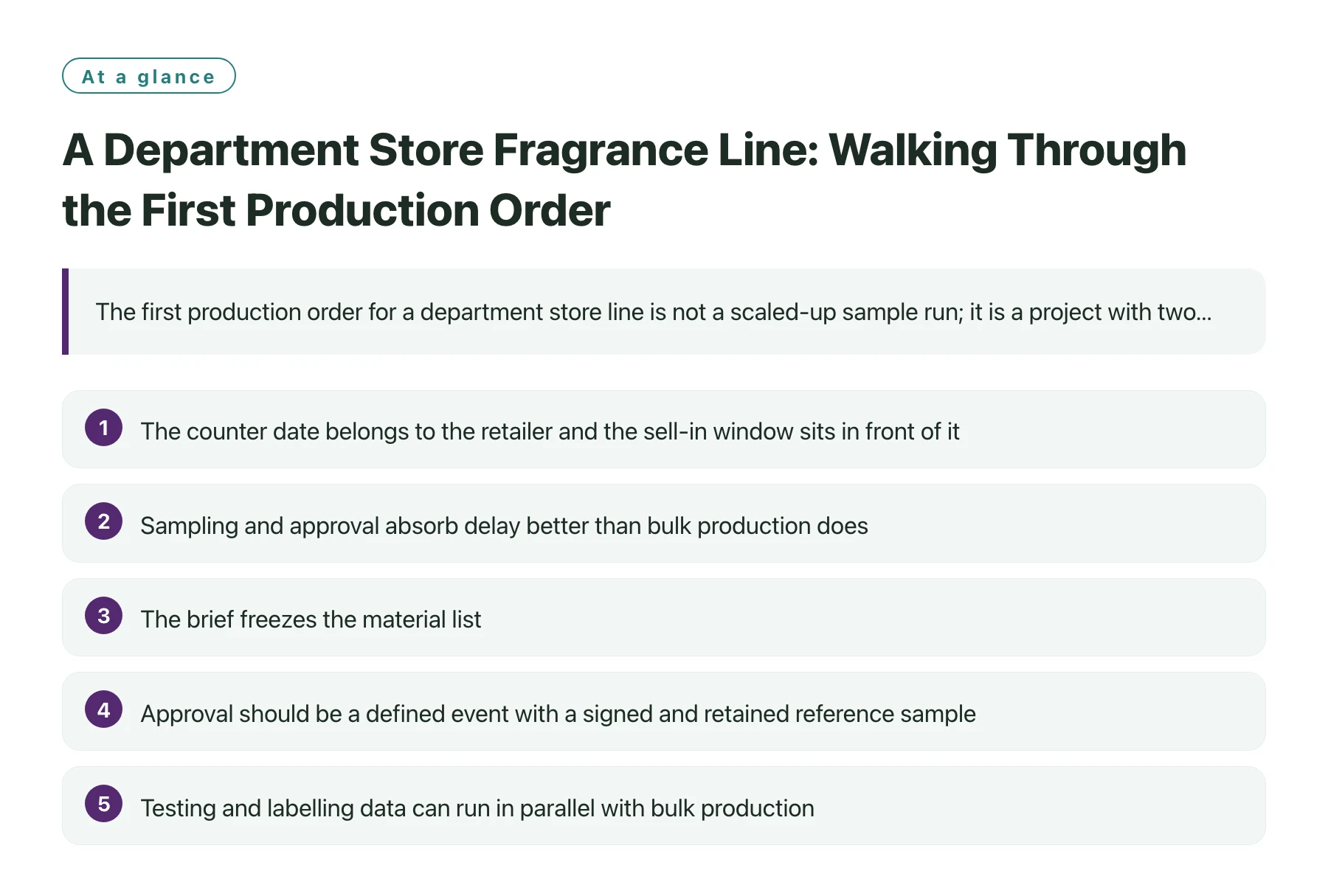
- The counter date belongs to the retailer and the sell-in window sits in front of it, so the order should be scheduled backwards from delivery rather than forwards from the purchase order.
- Sampling and approval absorb delay better than bulk production does, which makes them the stages to protect when a schedule tightens.
- The brief freezes the material list, including East Asian materials such as osmanthus, tea, jasmine, sandalwood and ginger, and a later change to that list resets at least part of the work.
- Approval should be a defined event with a signed and retained reference sample, because everything downstream is judged against that sample rather than against the conversation around it.
- Testing and labelling data can run in parallel with bulk production, but only if they were commissioned before bulk started rather than after [1].
- Sell-in windows follow the retailer's category calendar, and fragrance demand in the category is strongly seasonal, which is the kind of consumer pattern that beauty and personal care market research reports on continuously [2].
A brand's first production order for a department store line usually arrives with the counter date already promised and the sell-in window already agreed with the retailer. That single fact shapes everything else, because the order is not a manufacturing project with a retail date attached to it; it is a retail commitment with a manufacturing project inside it. Compare the stage list below against what a shortlisted manufacturer publishes on the company's official site before the first call, because the sequence is standard even when the answers are not.
The awkward part is that most stages feel negotiable while the order is running and turn out not to have been. A week lost in sampling looks harmless in month one and is the reason a shipment misses a booking in month four. The walkthrough below follows the order stage by stage and marks the decisions that cannot be revisited once they are made.
It applies to any fragrance line, but it is written with East Asian materials in mind, because osmanthus, jasmine, tea, sandalwood and ginger are both the materials most likely to lead a first collection and the ones most likely to change behaviour between a sample and a production batch. The sequence of stages is broadly the same across the industry; Xuelei, a Guangzhou fragrance manufacturer that states 31 years of manufacturing experience, publishes a comparable process, and what separates suppliers is how early they flag a problem rather than the order of the steps.
The first order, stage by stage
- Enquiry and capability fitThe order opens with a request that names the category, the target retail price band and the counter date. The useful answer at this point is not a price but a fit: whether the factory's categories, minimum order quantities and lead times can hold that date at all. A supplier that flags a conflict here saves months; one that quotes first and reveals constraints later does not. It helps to arrive with the counter date and the sell-in window written down, because nobody can schedule against a date that has not been stated.
- Brief and cost targetThe brief fixes the scent direction, the product categories, the pack formats and the price the line has to hit at retail. For an East Asian collection this is where the material list is effectively decided, since naming osmanthus, tea, jasmine, sandalwood or ginger sets a cost and sourcing envelope that is hard to renegotiate later. The brief should say which of those materials are fixed by name and which are directional, because the two are handled quite differently downstream.
- Sampling and revisionThe factory returns a small set of development directions, usually two to four, and the brand selects and comments. This stage has the most schedule elasticity in the whole order, and it is also where a brand usually discovers what its own brief actually meant. Each revision round costs calendar time, so the number of rounds covered by the quotation should be settled before the first sample is requested.
- Approval and reference retentionApproval is the hinge of the order. Once a sample is signed, it becomes the reference against which production is judged, and it should be physically retained by both sides with a date attached to it. Approving informally, through a comment in a message thread or a verbal yes on a call, is the most common way a first order loses its footing, because there is nothing to measure a later batch against.
- Bulk production and parallel workBulk compounding, filling and packing run against the approved reference, while testing, labelling artwork and packaging production run alongside them. Whether that parallelism is available depends on what was commissioned earlier; a partner that offers their OEM/ODM manufacturing services across R&D, filling and packaging can hold those tracks together, whereas a supply chain split across several vendors tends to serialise them and add weeks.
- Release, delivery and counter set-upThe order is released against the agreed documents, shipped, and booked into the retailer's distribution centre inside the sell-in window. The counter date follows the delivery date rather than the other way round, and counter samples, testers and display units normally travel with the same shipment. An order that arrives early is a storage problem; one that arrives late is an empty space on the shelf.
Two places where the calendar is decided
Most of the first order is mechanical once the reference is fixed. The difficulty sits in two areas: the paperwork that has to move with the goods, and the retail date that everything else is arranged around.
The documents and approvals that move with the order
A fragrance shipment for a retail channel travels with more than bottles. There is a certificate of analysis or an equivalent release document, a batch record reference, safety documentation for the formula, labelling inputs including any allergen declaration the destination market requires, and shipping documentation that matches the pack specification exactly. A third-party testing and inspection provider such as SGS describes this as a package of microbiological, stability and safety work aligned with cosmetics GMP, and reading one of those service descriptions before the first order is a quick way to see what a complete set looks like [1].
The practical issue is sequencing. Labelling and artwork approvals depend on the formula, so they cannot be completed before the formula is fixed, and they should not be left until the goods are packed. Brands that treat documentation as an afterthought routinely hold a finished pallet for a week waiting on a single declaration page, and on a first order there is no buffer to absorb that. Looking at examples of fragrance projects is a fast way to judge how much of this a factory expects to handle itself.
Where a retail launch date gets exposed
The counter date belongs to the retailer, and the sell-in window in front of it belongs to the retailer as well. Both are set by the category calendar rather than by the supplier, and category calendars follow consumer demand: fragrance assortments are reviewed around seasonal peaks, and demand in the category is strongly seasonal, a pattern that market research on beauty and personal care covers continuously [2]. A brand that misses a window generally waits for the next review instead of shipping late into the current one.
That makes the exposure easy to locate. It is rarely in the production line, which is usually the most predictable part of the order. It is in the two approval events that belong to the brand: brief sign-off and sample approval. Those are the dates worth diarising, because nearly everything downstream is a consequence of them, and no amount of factory capacity compensates for an approval that sat unsigned for ten days.
On a first order, the cheapest insurance is a schedule with named dates and named owners on both sides. Put the counter date at the top, work backwards through sell-in, delivery, bulk, approval and sampling, and mark which dates belong to the brand and which belong to the manufacturer. Most first-order slippage happens at a brand-side approval that nobody had put in a calendar, and the kind of walkthrough described at from idea to a perfume brand exists to make those points visible before they turn into delays.
Sources
- SGS: Cosmetics, Personal Care & Household Testing —— Testing, inspection and certification services for cosmetics and personal care, including microbiological, stability and safety testing aligned with cosmetics GMP.
- Mintel Press Centre —— Mintel's press releases on consumer and beauty market research, including fragrance and personal care trend reporting.
Frequently asked questions
How long does a first fragrance production order take?
It depends on how many sampling rounds the brief needs and how quickly approvals are signed, but the order is best understood as two blocks: development and sampling, then bulk production, testing and delivery. The production block is relatively predictable; the development block varies with the number of revision rounds and with how fast the brand responds at each approval point.
What is a retail sell-in window and why does it matter?
It is the period in which a retailer accepts stock into its distribution centre before a counter date or a seasonal review. Missing it usually means waiting for the next category review rather than shipping late into the current one, which is why the window, not the counter date alone, is the deadline a first order should be scheduled against.
Should the approved reference sample be kept by the brand or the factory?
Both. The factory needs a retained reference to compare production against, and the brand needs its own sealed copy to check a delivery independently. What matters is that the reference is physical, dated, and tied to a written approval, so that any later disagreement is settled by comparison rather than by recollection.
Do East Asian materials such as osmanthus, tea or sandalwood change the production timeline?
They can. Seasonal materials such as osmanthus absolute depend on harvest availability, expensive materials such as sandalwood invite substitution decisions, and accords such as tea may be rebuilt if a component changes. Making those decisions at the brief stage rather than during bulk production is what keeps them from moving the delivery date.
What documents should arrive with the first shipment?
Typically a release document such as a certificate of analysis, a batch record reference, the safety and labelling inputs for the formula, and shipping paperwork that matches the approved pack specification. Confirm the list in the scope before production starts, because compiling it after the goods are packed is where first orders lose days.