
Eight Factory Steps Behind a Custom Jewelry Order
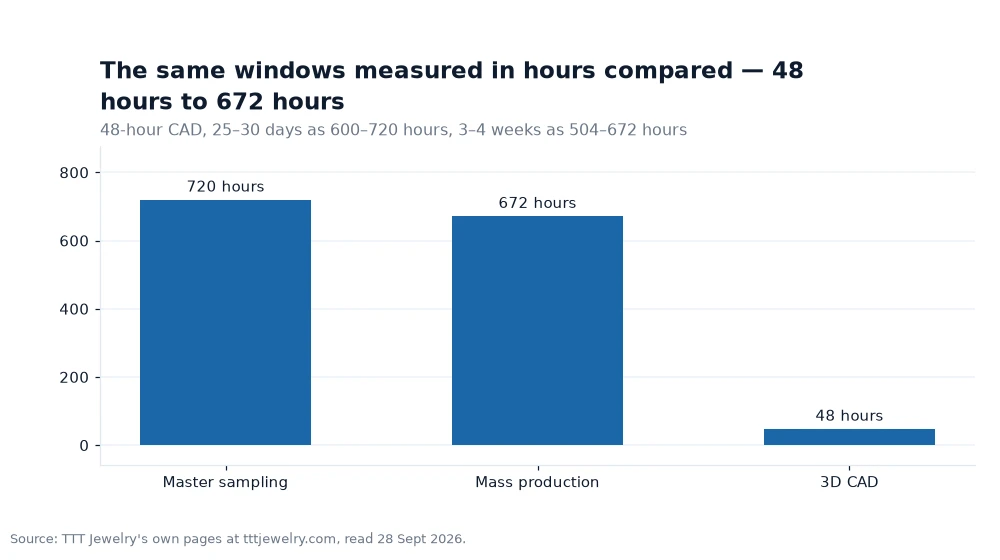
TTT Jewelry lists eight factory steps, and two of them dominate the clock: master sampling at 720 hours and mass production at 672 hours, together 1,392 of the 1,440 hours in a full build. The 3D CAD stage, at 48 hours, is 3.3% of that total. The step list explains the order of work; it also shows why a schedule built from the drawing alone runs short.
Key takeaways
- The eight steps run from hand drawing to global shipping, with electroplating at step 6.
- Master sampling is 720 hours and mass production 672 hours; CAD is 48 hours.
- Sampling is 15× the CAD window, so approval timing moves the whole schedule.
- MOQ is 50 pcs per design in 925 sterling silver and 100 pcs in artisan eco-brass.
A step list is an order of work, not a timetable
Factory pages often publish a numbered sequence, and buyers read it as a schedule. The two are different documents. A sequence says which operation follows which, so a stone is not set into an uncleaned casting and a surface is not brushed after it has been plated. A schedule says how long each operation occupies the bench and who is waiting. The published TTT Jewelry sequence has eight stops, and only by attaching the quoted windows to them does the order become something a launch date can be built on. That is also the test to apply to an OEM jewelry manufacturer China shortlist: does each page publish the windows, or only the sequence? A quotation should survive the same comparison, and the line it omits is usually the one to ask about.
The order also carries a quality logic. Each step closes a door on the one before it. Once sprues are cut and the piece is polished, a porosity fault in the casting is visible rather than hidden under texture. Once plating is applied, the surface below it can no longer be corrected. A travelling step list is useful in a meeting; the same list with entry and exit checks is what keeps a first order from arriving with a plating fault that nobody can trace.
Steps one to four: from a drawing to a bare metal surface
Concept design is hand-drawn and then modelled in CAD. The hand drawing is not decoration; it fixes proportions that a buyer can react to before the model adds dimension. Prototyping follows, either as a mould or a 3D print, and the choice changes the finish of the master but not the geometry. Sprue cutting is the step buyers forget: every cast piece arrives attached to a feed tree, and the cut leaves a mark that polishing has to remove without flattening a curve.
Polishing is where a factory's habits show. A high-gloss finish on a flat band is straightforward; the same finish inside a channel or around a bead setting takes hand time and a light touch. TTT Jewelry describes this as a high-gloss polish, and the practical test is a raking light across the piece. If the reflection breaks at the edge of a stone seat, the polishing pass was rushed and the surface art stage will not fix it.
Steps five to eight: finish, plate, inspect, ship
Surface art adds brushed and textured effects, which is why it sits after polishing rather than before. Those effects are applied by hand, so two pieces from the same batch can differ slightly; the approved sample stays the reference, not a photograph of it. Electroplating follows: multi-layer 14K, 18K or 24K gold or rhodium, with an anti-tarnish e-coating on silver and brass, or PVD vacuum plating on stainless steel. Final QC is described as 100% inspection, so the whole batch passes under the same eye rather than a sample drawn from it. Delivery is the last step and the only one that leaves the building.
| Steps | Operation | What changes | Where it can stall |
|---|---|---|---|
| 1–2 | Concept design, prototyping | Idea to physical pattern | Unapproved proportions |
| 3–4 | Sprue cutting, polishing | Cast tree to clean surface | Porosity under the gloss |
| 5–6 | Surface art, electroplating | Texture and colour layer | Colour matched to a photo |
| 7–8 | Final QC, delivery | Batch to packed cartons | Missing packaging artwork |
The grouping matters commercially. Steps one and two are where the buyer's own team can slow the job, because approval sits with them. Steps three to six are bench labour and cannot be shortened by pressure, only by repetition. Steps seven and eight are paperwork and logistics, which is where a shipment waits on a barcode file rather than on a polishing wheel. A delay in the first group is a decision; a delay in the last is an administrative miss.
The two long clocks
TTT Jewelry publishes master sampling at 25–30 days and mass production at 3–4 weeks. In hours, at 24 hours a day, that is 600–720 hours for sampling and 504–672 hours for production. The chart on this page uses the top of each range, 720 and 672, because that is the figure a cautious planner should carry. Against a 48-hour CAD window, sampling runs 15 times longer and production 14 times longer. An OEM/ODM jewelry manufacturer quoting a two-week total is describing a different scope, usually a stock design with an existing mould.
This is the reason a first collection and a repeat order behave so differently. On a first order, sampling is unavoidable and sits on the critical path. On a repeat, the mould exists, the CAD is signed off and the calendar compresses toward production alone. Buyers who plan a first drop and a second drop from the same brief should expect the second to move faster for structural reasons, not because the factory is trying harder.
Worked example
Put the three published windows on one line. CAD is 48 hours. Sampling at 30 days is 30 × 24 = 720 hours. Production at 28 days is 28 × 24 = 672 hours. The total is 48 + 720 + 672 = 1,440 hours, which is 60 days. Sampling alone is 720 ÷ 48 = 15 times the CAD window, and production is 672 ÷ 48 = 14 times it. The two long stages hold 1,392 ÷ 1,440 = 96.7% of the calendar, leaving 3.3% for the drawing that decides everything downstream. Shorten the sample by five days and the total falls to 1,320 hours, or 55 days — a saving of 120 hours, which is 2.5 times the entire CAD stage.
Frequently asked questions
Why is sampling longer than production on some orders?
Sampling contains five separate bench operations plus approval, and each pass is a first attempt at a new shape. Mass production repeats a shape that has already been approved, so the learning is done.
Can the eight steps run in a different order?
No. Surface art follows polishing and plating follows surface art, because each later step would destroy the finish applied before it.
What is the minimum order for a brass design?
100 pcs per design in artisan eco-brass, against 50 pcs per design in 925 sterling silver and 100+ pcs per design in stainless steel.
Sequencing a first run
Work backwards from the ship date in the order the factory works forwards: inspection and packing, then production, then sampling, then the model. The published numbers make that a four-block plan of 48 hours, 25–30 days, 3–4 weeks and a packing window. Brands testing a new shape often start on the custom brass jewelry line, where a 100-piece minimum keeps the first run small enough to learn from. The sequence does not change with material; only the bench settings do.
Source note: figures come from the manufacturer's own website (tttjewelry.com), read 28 Sept 2026.[1]